
THE INNER WAR OF THE SOUL
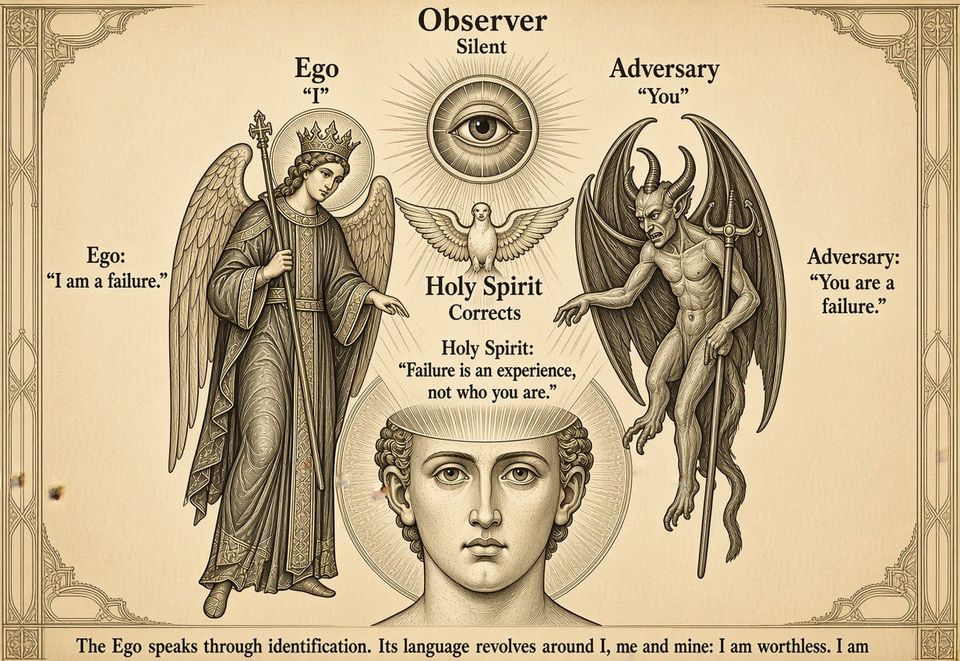
Understanding the Ego, the Adversary, and the Holy Spirit Through Ancient Christian Wisdom, Psychology, and Spiritual Discernment
I. The Three Dimensions of the Inner Conflict
Within the human experience, there exists a continual struggle between desire, identity, reason, conscience, and the pursuit of truth. This struggle is not always visible to the external world. It unfolds within the interior life of the individual, where thoughts arise, emotions develop, desires demand satisfaction, and decisions gradually shape character.
Ancient Christian thinkers understood this struggle as part of the spiritual life. They recognized that not every thought deserves obedience, not every desire reflects the good, and not every internal persuasion originates from wisdom.
In modern psychological language, we may examine this conflict through the ego, understood here as the psychological structure through which a person identifies with their thoughts, emotions, and personal narrative.
Christian theology introduces two additional dimensions: the Adversary, associated with temptation, deception, and opposition to God; and the Holy Spirit, understood not merely as an aspect of human psychology but as the divine Person who guides believers toward truth, holiness, and communion with God.
These are not three equal forces operating inside the mind. They belong to different categories: the ego is a psychological concept, the Adversary is a spiritual being within Christian theology, and the Holy Spirit is God.
Nevertheless, examining their distinct roles offers a framework for understanding the relationship between thought, temptation, freedom, and spiritual maturity.
II. The Ego: When Experience Becomes Identity

The ego speaks through identification.
Its language revolves around I, me, mine, and the constant preservation of an imagined personal identity.
I am worthless.
I am angry.
I need this.
I deserve this.
I cannot allow them to disrespect me.
I must prove that I am better.
I cannot survive without this person.
The underlying psychological movement is subtle but important.
An emotional experience arises within consciousness, and the mind immediately converts that temporary experience into a statement about the identity of the individual.
Anger is no longer something being experienced; it becomes I am angry.
Fear is no longer a passing emotional response; it becomes I am afraid.
A desire emerges within the body, and the mind transforms it into a personal command: I want this, therefore I must have it.
Through repeated identification, temporary mental conditions begin to define the person’s understanding of the self.
A moment of rejection becomes a declaration of worthlessness. A temporary failure becomes a permanent identity of inadequacy. An insult becomes a threat against the entire psychological structure through which the individual understands personal dignity.
This is how awareness becomes absorbed into its psychological mask.

Rather than recognizing thoughts and emotions as experiences that can be examined, the individual begins treating them as unquestionable descriptions of reality.
The distinction is significant:
To experience anger does not mean that anger defines the person.
To experience fear does not mean that fear must control behavior.
To experience desire does not establish an obligation to satisfy that desire.
The ability to observe an impulse without immediately obeying it introduces a degree of psychological freedom.
This principle also has a parallel within ancient Christian spirituality.
In Romans 12:2, the Apostle Paul writes:
“Be ye transformed by the renewing of your mind.”
This transformation is not merely a matter of suppressing negative thoughts. It involves changing the way the individual understands, evaluates, and responds to the contents of the mind.
The ego becomes especially destructive when self-preservation develops into pride.
Pride persuades the person that personal feelings must always be defended, personal opinions must always be correct, and personal desires must receive immediate consideration.
Under such conditions, correction becomes humiliation, disagreement becomes hostility, and forgiveness appears to be weakness.
The individual is no longer responding only to the external event. The individual is defending an identity that feels threatened.
The ego says: I must protect the image I have constructed of myself.
Spiritual maturity, by contrast, requires the ability to acknowledge fault without believing that personal worth has been destroyed.
Humility does not require self-hatred. It requires the willingness to encounter truth without allowing pride or shame to distort it.
III. The Adversary: The Architecture of Temptation
The word Satan is associated with the Hebrew concept of an adversary, while the Greek term diabolos carries the meaning of a slanderer or accuser.
Within Christian theology, the Adversary represents opposition to God through deception, temptation, accusation, and the distortion of truth.
Psychologically, the language of temptation can be studied through the thoughts that encourage an individual to rationalize destructive behavior.
You are worthless.
You cannot accomplish this.
You deserve more than everyone else.
Nobody will discover what you have done.
You can repent tomorrow.
You have already failed, so why stop now?
They humiliated you. Make them suffer.
Such thoughts can arise from ordinary psychological processes, habits, anxiety, or internalized experiences. Christianity does not require every destructive thought to be attributed to demonic activity.
The spiritual significance lies in the manner through which temptation attempts to redirect the will.
Temptation rarely presents itself as destruction.
It often appears as justification.
The body experiences craving, and thought constructs a persuasive explanation for satisfying it.
Lust arises, and reason is recruited to defend immediate gratification.
Anger develops, and the mind begins constructing an argument for retaliation.
Envy appears, and thought transforms another person’s success into evidence of personal injustice.
Fear arises, and the mind may exaggerate danger until avoidance seems like the only rational decision.
The emotion itself does not necessarily constitute wrongdoing. Anger may reveal an injustice. Fear may warn of real danger. Desire may express a legitimate human need.
The moral question concerns how those experiences are interpreted and what the individual freely chooses to do with them.
The Ancient Pattern of Deception
In Genesis 3:1–6, the serpent does not begin by physically compelling Eve to disobey God.
Instead, temptation begins through questioning, reinterpretation, and persuasion.
The serpent challenges the divine command, contradicts its consequences, and presents disobedience as a path toward gaining something desirable.
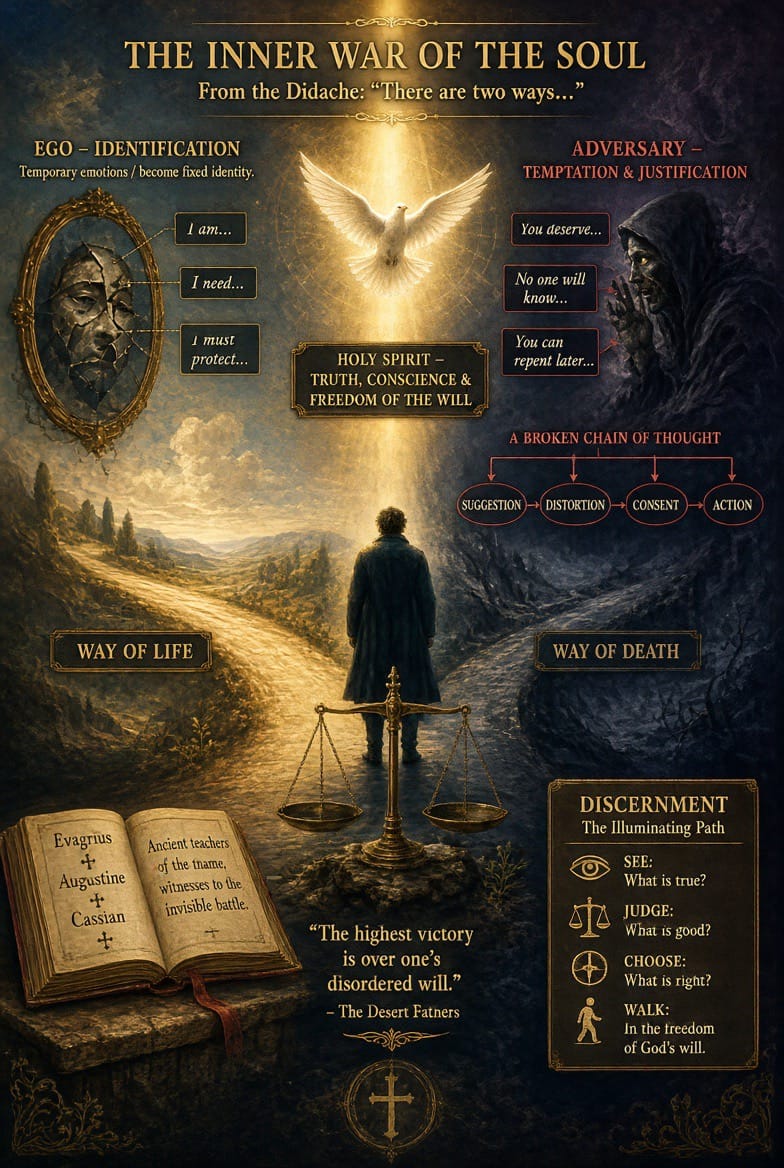
The pattern can be understood through four stages:
- Suggestion: A possibility enters the mind.
- Distortion: The consequences or moral meaning of the action are reinterpreted.
- Consent: The individual begins accepting the persuasive argument.
- Action: The will moves toward the proposed behavior.
The most dangerous stage is frequently not the original desire but the moment when reason begins serving the desire instead of evaluating it.
An individual may possess sufficient intelligence to recognize wrongdoing and still use that intelligence to justify it.
This is one of the central paradoxes of the human condition: intelligence does not automatically produce wisdom.
The Adversary, understood in the Christian spiritual framework, does not need to eliminate human freedom. Temptation seeks to influence the choices made through that freedom.
IV. Evagrius Ponticus and the Eight Tempting Thoughts
During the fourth century, the Christian monk and theologian Evagrius Ponticus developed a detailed analysis of destructive thoughts.
He used the Greek word logismoi (λογισμοί), referring in this context to tempting thoughts or mental suggestions capable of disturbing the soul.
In his work Praktikos, section 6, Evagrius identifies eight principal categories:
- Gluttony — disordered consumption.
- Sexual immorality — disordered sexual desire.
- Love of money — excessive attachment to wealth.
- Sadness — spiritually destructive despondency.
- Anger — hostility capable of controlling judgment.
- Acedia — spiritual weariness and resistance to one’s duties.
- Vainglory — the pursuit of admiration and personal recognition.
- Pride — the elevation of oneself above others and dependence on God.
These ideas influenced the later Christian tradition concerning the deadly sins.
Evagrius made an important distinction between the arrival of a thought and the response given to it.
A thought may appear without deliberate invitation. Its appearance does not automatically mean the person has chosen to entertain or obey it.
The question is whether the person deliberately nourishes the thought, repeatedly returns to it, and allows it to shape the will.
Consider a person who experiences resentment.
The original sensation may arise spontaneously after being treated unfairly.
However, the individual may then repeatedly imagine revenge, rehearse the insult, create arguments defending retaliation, and eventually develop an intention to harm another person.
What began as an emotional reaction becomes a cultivated disposition.
Evagrius understood that spiritual discipline involves examining these movements before they become entrenched.
The goal is not the impossible elimination of every unwanted thought. It is the cultivation of freedom from unnecessary submission to destructive thoughts.
A thought can enter the mind without becoming the master of the will.
V. St. Augustine: The Divided Human Will
St. Augustine of Hippo examined the conflict between knowledge, desire, and moral action with remarkable psychological depth.
In Confessions, Book VIII, Augustine describes his struggle to abandon habits that he intellectually understood to be spiritually harmful.
He famously admitted praying:
“Grant me chastity and continency, but not yet.”
This statement reveals the difference between recognizing the good and genuinely willing to pursue it.
Augustine wanted transformation, but he also wanted to preserve the pleasures and habits that prevented transformation.
His struggle was not simply ignorance.
It was divided desire.
One part of his will sought God, while another remained attached to the familiar satisfaction of old behaviors.
Augustine described this as a conflict within a single human will, not as evidence that the person possesses two fundamentally separate souls.
This distinction remains deeply relevant.
An individual may desire discipline while simultaneously desiring comfort.
A person may want honesty while fearing the consequences of telling the truth.
Someone may sincerely desire a stable relationship while repeatedly acting according to impulses that undermine trust.
A person may wish to forgive while continuing to rehearse the injury that sustains resentment.
The inner conflict is not resolved merely by acquiring more information.
It requires the gradual formation of the will through practice, grace, self-examination, and deliberate action.
Augustine also expressed the deeper spiritual restlessness of humanity in Confessions, Book I:
“Our hearts are restless until they rest in You.”
His meaning was theological: the human heart cannot ultimately find its fulfillment in finite possessions, status, pleasure, or admiration because it was created for communion with God.
From this perspective, the ego continually searches for lasting security in temporary things.
The Adversary exploits disordered attachment.
And the work of divine grace redirects the individual toward the good that cannot be reduced to immediate gratification.
VI. The Holy Spirit: Truth, Conscience, and the Higher Will of God
The Holy Spirit occupies an entirely different position within Christian thought.
In the doctrine of the Trinity, the Holy Spirit is not simply a psychological function, moral instinct, or elevated form of self-awareness.
The Holy Spirit is divine.
Within the Christian understanding of spiritual life, the Spirit enlightens conscience, strengthens the will, convicts believers of wrongdoing, and directs them toward truth and holiness.
Christ speaks of the Spirit of truth in John 16:13, promising that the Spirit will guide his followers into truth.
The guidance of the Holy Spirit is not necessarily experienced as an audible voice.
It may be recognized through a properly formed conscience, deeper understanding of Scripture, prayer, moral conviction, wise counsel, and a growing willingness to choose what is good.
Within ordinary experience, this can appear remarkably simple:
Do not send the message written in anger.
Tell the truth, even if lying would be easier.
Keep the promise you made.
Admit your mistake.
Do not exploit another person’s vulnerability.
Forgive without pretending the wrongdoing was acceptable.
Fulfill your responsibilities.
Do not sacrifice your integrity for temporary pleasure.
These instructions are examples of morally sound judgments, not a claim that every such thought is a direct communication from God.
The difference between spiritual wisdom and impulsive desire often becomes evident through their direction.
Destructive temptation tends to narrow attention toward immediate emotional relief, revenge, vanity, or gratification.
Sound conscience encourages the individual to consider truth, responsibility, justice, love, and long-term consequences.
But calmness alone is not evidence of divine guidance, just as discomfort is not evidence of spiritual error. Sometimes doing what is right requires courage, grief, sacrifice, or the establishment of firm boundaries.
The Apostle Paul describes the fruit of the Spirit in Galatians 5:22–23 as love, joy, peace, patience, kindness, goodness, faithfulness, gentleness, and self-control.
These qualities provide a more reliable measure of spiritual growth than the intensity of an internal feeling.
The Holy Spirit does not merely encourage a person to feel righteous. Divine grace calls the person to become righteous through love, truth, repentance, and faithful action.
VII. John Cassian: Not Every Thought Should Be Believed
In the fifth century, John Cassian developed a detailed teaching on the discernment of thoughts.
In Conferences, First Conference, chapters 19–20, Cassian describes three possible origins of thoughts within his theological framework: God, the devil, and the individual person.
This distinction is particularly valuable because it rejects the assumption that every thought is either divine or demonic.
Many thoughts arise through ordinary memory, habit, imagination, and the natural operations of the human mind.
Cassian compares spiritual discernment to the work of a skilled money-changer examining coins.
A counterfeit coin may resemble genuine gold.
Likewise, a harmful suggestion may resemble wisdom, compassion, justice, or religious devotion.
An individual might say:
I am confronting this person because I love truth.
Yet beneath the declaration may be a desire to humiliate.
Someone may insist:
I am only defending my dignity.
But beneath the argument may be wounded pride seeking revenge.
Another person may declare:
God wants me to accomplish great things.
Yet personal ambition may have become detached from honesty, humility, and responsibility.
Cassian’s principle requires more than examining the language used to defend an intention.
It requires examining its substance and consequences.
One must ask whether the thought is consistent with truth, whether it promotes virtue, and whether it is being distorted by pride or desire.
This is why 1 John 4:1 instructs Christians to test the spirits rather than believing every spiritual claim.
The purpose of discernment is not endless suspicion toward one’s own mind.
It is the formation of wise judgment.
VIII. The Ancient Teaching of the Two Ways
One of the earliest Christian instructional writings, the Didache, opens with a striking moral distinction:
“There are two ways, one of life and one of death.”
The Didache, chapter 1, presents spiritual life as a path defined by love of God, love of neighbor, and practical moral conduct.
The teaching is significant because it directs attention away from abstract claims about spiritual superiority and toward the concrete expression of character.
The path of life is not established by how enlightened a person believes themselves to be.
It is revealed through conduct.
A person may understand theology while behaving dishonestly.
An individual may speak extensively about humility while remaining controlled by vanity.
Someone may appear disciplined in public while privately cultivating resentment, envy, or cruelty.
For the ancient Christian writers, authentic spiritual development required bringing outward behavior into agreement with inward conviction.
It was insufficient to recognize the truth while repeatedly refusing to act upon it.
Faith required transformation.
Knowledge required obedience.
And spiritual maturity required the gradual alignment of thought, desire, and action with the love of God.
IX. The Sequence of the Inner Struggle
The relationship between thought, emotion, temptation, and moral choice can be illustrated through an ordinary experience.
Imagine that an individual receives a disrespectful message.
The first movement is emotional.
The person experiences anger, embarrassment, or disappointment.
The body’s defensive response becomes activated.
At this point, an emotion is being experienced, but no moral decision concerning retaliation has necessarily been made.
The second movement is identification.
The ego begins constructing a personal narrative:
They think I am weak.
I cannot allow anyone to treat me this way.
If I do not respond immediately, I will lose my dignity.
The individual is no longer considering only the message itself. The mind has connected the event to personal identity.
The third movement is justification.
A persuasive thought emerges:
They deserve to be humiliated.
Send the message.
Make them understand who they are dealing with.
You can apologize afterward.
Now reason is being used to make retaliation appear necessary or acceptable.
The fourth movement is discernment.
The person may recognize:
I have been offended, but I do not have to become cruel.
My dignity does not depend on humiliating another individual.
I can address the disrespect without surrendering self-control.
Here, awareness creates the possibility of choosing a response rather than obeying an impulse.
The fifth movement is the exercise of the will.
The person chooses to wait, respond respectfully, establish an appropriate boundary, or withdraw from an unproductive exchange.
The external situation may remain unresolved.
Yet an important internal victory has occurred.
The person has refused to allow a temporary emotion to dictate the character of the response.
This is not passivity.
It is disciplined freedom.
X. The Difference Between Suppression and Transformation
It is important to distinguish spiritual discipline from emotional suppression.
To suppress anger is to deny its existence or refuse to examine its cause.
To transform one’s relationship with anger is to recognize it, understand what it reveals, and choose an appropriate response.
To suppress fear is to pretend that danger does not exist.
To exercise courage is to evaluate fear carefully and act according to wisdom rather than panic.
To suppress desire is to treat every human longing as shameful.
To practice temperance is to place desire within the proper limits of reason, morality, and love.
Ancient Christian spirituality did not universally seek the elimination of emotion. It sought the purification and proper ordering of human desires.
This is especially evident in the virtue of temperance and in the Christian understanding of charity.
Human love is not destroyed through spiritual development.
It becomes less possessive, less selfish, and more capable of seeking the genuine good of another person.
Similarly, humility does not destroy human dignity.
It frees the individual from the constant need to prove that dignity through comparison, domination, or public approval.
The ultimate objective is not to become a person without emotions.
It is to become someone whose emotions no longer exercise unquestioned authority over conscience and conduct.
XI. Spiritual Discernment and the Freedom to Choose
The Apostle Paul writes in 2 Corinthians 10:5 of bringing thoughts into obedience to Christ.
In its original context, the passage concerns opposition to arguments raised against the knowledge of God. Applied to personal spiritual reflection, it also encourages serious examination of beliefs and mental arguments.
A mature Christian response to an internal suggestion therefore involves several questions:
- Is this thought truthful, or does it distort reality?
- Is this desire legitimate, or am I using it to justify wrongdoing?
- Am I acting through love and justice, or through pride and resentment?
- Will this action strengthen my integrity or weaken it?
- Is my conscience informed by Scripture, sound reason, and trustworthy counsel?
- Would I defend this choice if its motives were fully exposed?
These questions are not intended to produce relentless self-interrogation.
Their purpose is to clarify the will.
Repeated examination, guided by wisdom, can help reveal the difference between what a person genuinely values and what a person momentarily desires.
A choice made under the influence of anger may feel justified in the present.
A choice made through vanity may feel like ambition.
A choice made through fear may appear prudent.
But time, honest reflection, and the consequences of action frequently expose the underlying motivation.
Spiritual maturity grows when the individual becomes willing to accept those discoveries without denial.
XII. The Highest Victory Is Not Over Another Person, but Over One’s Disordered Will
The deepest spiritual battles are not necessarily the ones fought against visible enemies.
They often take place when no one is watching.
When a person has the opportunity to lie without being discovered.
When someone is tempted to betray a promise for personal advantage.
When pride demands retaliation.
When desire argues against discipline.
When resentment makes forgiveness appear impossible.
When an individual knows what ought to be done but feels strongly inclined to do otherwise.
These moments reveal the character being formed beneath the external personality.
The ego asks whether the self has been honored.
Temptation asks whether immediate satisfaction can be obtained.
Conscience asks whether the proposed action is right.
And within Christian faith, the believer seeks the grace of the Holy Spirit to recognize and follow the will of God.
The spiritual life is therefore not simply about the absence of destructive thoughts.
It concerns what an individual chooses to love, cultivate, reject, and obey.
Freedom is not the ability to satisfy every desire.
Freedom, in its deeper moral meaning, is the growing capacity to choose the good even when competing desires make that choice difficult.
The individual who must answer every insult remains dependent on the behavior of others.
The individual who must satisfy every craving remains dependent on appetite.
The individual who requires constant admiration remains dependent on public opinion.
But the person who develops humility, temperance, courage, and love becomes less easily governed by these external and internal pressures.
XIII. Conclusion: The Discipline of the Soul
The ego, the Adversary, and the Holy Spirit should not be confused with one another, yet examining their roles reveals something important about human freedom.
The ego, when ruled by excessive identification and pride, turns temporary experiences into seemingly permanent truths about the self.
Temptation seeks to persuade the will through distorted reasoning, immediate gratification, accusation, or false promises.
The Holy Spirit, according to Christian faith, draws the believer toward truth, repentance, love, wisdom, and conformity to the will of God.
Ancient Christian writers understood that the decisive question is not simply what appears within consciousness, but what is welcomed, cultivated, and translated into action.
An individual can experience anger without becoming unjust.
Can experience fear without abandoning courage.
Can experience desire without surrendering discipline.
Can encounter temptation without granting it consent.
And can acknowledge personal weakness without surrendering hope.
The task is not to wage war against every passing thought. It is to cultivate discernment, strengthen the will, practice virtue, and remain receptive to divine grace.
For the Christian, the ultimate purpose of this inner discipline is not the glorification of a stronger ego or the achievement of absolute self-sufficiency.
It is the transformation of the person through communion with God.
The highest expression of spiritual freedom is not found in declaring, I answer to no one.
It is found in the humility to say:
I am not required to obey every thought that enters my mind. I am not required to satisfy every desire that arises within me. I am not required to defend every wound inflicted upon my pride. I possess the freedom to examine my impulses, to reject what is destructive, and to choose what is true and good.
My emotions deserve understanding, but they do not possess absolute authority. My thoughts deserve examination, but they do not automatically constitute truth. My desires deserve discernment, but they do not determine my moral obligations.
The measure of my character is not the intensity of what I feel, but the integrity of what I choose.
And in the words of the ancient Christian tradition, the journey of the soul is ultimately a movement away from slavery to disordered desire and toward the freedom of a life directed by truth, love, and the grace of God.
Member discussion